Amazon vs eBay vs Etsy fees: what each takes on a $40 sale
Every marketplace charges differently, so the same sale leaves you with a different payout. This comparison uses a $40 item with $5 shipping charged to the buyer, with fee schedules for US sellers.
How each marketplace charges
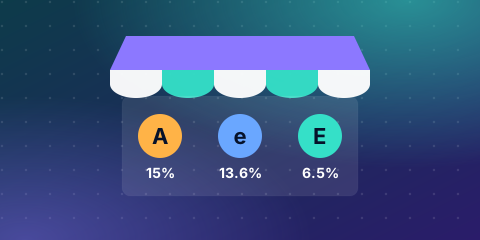
- Amazon: a referral fee of 15% of the item price in most categories (8% for consumer electronics, 5% to 17% for clothing by price band), with a $0.30 minimum. FBA and subscription fees are extra.
- eBay: a final value fee of 13.6% on item price plus shipping plus sales tax up to $7,500, plus a per-order fee of $0.30 on orders of $10 or less and $0.40 above that.
- Etsy: $0.20 per listing, a 6.5% transaction fee on item plus shipping, and payment processing of 3% plus $0.25 for US sellers. Offsite Ads fees are extra.
Fees on a $40 sale with $5 shipping
| Marketplace | Fees | As % of item price |
|---|---|---|
| Amazon (15% category) | $6.00 | 15.0% |
| eBay | $6.52 | 16.3% |
| Etsy (US) | $4.73 | 11.8% |
The point is not that one platform is always cheapest. Fees are charged on different bases, so low-priced items feel the fixed fees most and high-priced items feel the percentages most.
 Skip the maths, try your own numbersMarketplace Fee CalculatorFree, instant, no sign-up →
Work out your payout
Payout = item price + shipping charged − marketplace fees − shipping you pay. Subtract your product cost to get profit before ads and packaging.
Fee schedules change often, so confirm current rates on each official page before you set prices. Use the calculator below with your own price and category.
Comparison at a different price: a $100 item with free shipping
| Marketplace | Fee calculation | Total fees |
|---|---|---|
| Amazon (15%) | 15% of $100 | $15.00 |
| eBay | 13.6% of $100 + $0.40 | $14.00 |
| Etsy (US) | $0.20 listing + 6.5% + 3% + $0.25 | $9.95 |
At higher prices the percentage rates dominate, and the fixed per-order fees matter less. These examples use typical categories, so your category may differ.
Fees beyond the headline rate
- Amazon: the Professional selling plan has a monthly subscription. FBA adds fulfilment and storage fees, and advertising is separate.
- eBay: promoted listings, international fees and some category-specific rates.
- Etsy: Offsite Ads fees when a sale comes from an Etsy-run ad, plus currency conversion costs for some sellers.
Which platform fits which seller?
| Platform | Strength | Watch out for |
|---|---|---|
| Amazon | Huge buyer traffic, FBA logistics | Competition, strict policies, fee stacking |
| eBay | Used, collectible and niche goods, auctions | Fees on shipping and tax, buyer returns |
| Etsy | Handmade, vintage and craft supplies | Product rules, listing fees, Offsite Ads |
Calculate your true margin per sale
Take your selling price and subtract marketplace fees, shipping you pay, packaging, advertising and returns, then subtract the product cost. The result is your net profit. Many beginners price from the product cost alone and discover that fees and shipping erase the margin.
Pricing strategy tips
- Set a minimum price that keeps your target margin after fees.
- Test free shipping built into the price. It can raise conversion but also raises percentage-based fees.
- Compare cost per order for ads before you scale.
- Re-check fee schedules every few months.
Selling on more than one marketplace
Multi-channel selling spreads risk but adds complexity. Keep inventory in sync to avoid overselling, and calculate the margin per channel instead of assuming one price works everywhere.
Where do your own store and marketplaces fit?
A marketplace gives you traffic in exchange for fees. A store on your own domain gives you control and repeat customers but needs traffic of its own. Many sellers use marketplaces to find customers and an own store to keep them.
Check official fee pages
Fee schedules change often and differ by category and country. Confirm the current numbers on Amazon Seller Central, the eBay selling fees page and the Etsy fee help page before you set prices.
Troubleshooting: common problems and fixes
- Fees on my statement are higher. Look for FBA, advertising, subscription, international and currency fees that are not in the headline rate.
- My category has a different rate. Amazon and eBay set rates by category. Use the category rate in the calculator.
- Sales tax appears in the fee base. eBay calculates its fee on the total including sales tax and shipping up to a limit. Include it in the example.
- Shipping is free to the buyer. Build it into the price or treat it as a cost. Fees apply to different bases on each site.
- Payout timing is different. Each platform has its own payout schedule, which affects cash flow.
How accurate is this?
Rates in this guide come from the official Amazon, eBay and Etsy fee pages for US sellers and are used in a simple example. Fee schedules, category rates and promotions change often, so confirm current rates on each site before you set prices. Zyphub does not store your numbers.
More free Zyphub tools you may need
- Marketplace Fee Calculator: Amazon, eBay and Etsy fees and payout.
- E-commerce Net Profit Calculator: Real profit per order after all costs.
- Product Pricing & Break-even Calculator: Selling price, margin and break-even point.
Frequently asked questions
Which is cheaper to sell on, Amazon, eBay or Etsy?
It depends on price, category and shipping. On a $40 item with $5 shipping, Etsy is lowest in this example at $4.73, Amazon is $6.00 and eBay is $6.52.
Does eBay charge fees on shipping?
Yes. eBay’s final value fee is calculated on the item price plus shipping and sales tax up to a limit, plus a per-order fee.
What are Etsy’s fees?
A $0.20 listing fee, a 6.5% transaction fee on item and shipping, and payment processing, in the US 3% plus $0.25. Offsite Ads fees apply in some cases.
Are FBA fees included in the Amazon number?
No. The referral fee shown excludes FBA fulfilment, storage, subscription and advertising costs.
How do I calculate profit after marketplace fees?
Subtract fees, shipping, packaging, ad costs and product cost from your revenue. The profit calculator does this per order.
Which marketplace has the lowest fees?
It depends on item price, category, shipping and ads. Use the calculator with your own numbers to compare.
Is selling on Etsy cheaper than eBay?
For many items Etsy’s total fees are lower, but this changes with price, shipping and ads.